Sunday, December 28, 2008

Selamat Pengantin Baru


Selamat pengantin baru.
Selamat berbahgia.
Selamat ke anak cucu.
Selamat sejahtera.

Semoga berpanjangan.
Semoga berkekalan.
Semoga satu tujuan.
Semoga aman.

Hidup mestilah rukun.
Sabar paling perlu..
Cinta setiap hari..
Senyum mesti selalu.
-- Saloma

Tahniah Dora atas selamatnya majlis perkahwinan dan akad nikah abang Syazwan dan kakak Zakiah. Semoga senantiasa dicucuri berkat Ilahi sehingga ke anak cucu.

Wednesday, December 24, 2008

Magnificat


Lalu kata Maria: "Jiwaku memuliakan Tuhan,
dan hatiku bergembira karena Allah, Juruselamatku,
sebab Ia telah memperhatikan kerendahan hamba-Nya.

Sesungguhnya, mulai dari sekarang
segala keturunan akan menyebut aku berbahagia,
karena Yang Mahakuasa telah
melakukan perbuatan-perbuatan besar kepadaku
dan nama-Nya adalah kudus.

Dan rahmat-Nya turun-temurun atas orang yang takut akan Dia.
Ia memperlihatkan kuasa-Nya dengan perbuatan tangan-Nya
dan mencerai-beraikan orang-orang yang congkak hatinya;

Ia menurunkan orang-orang yang berkuasa dari takhtanya
dan meninggikan orang-orang yang rendah;

Ia melimpahkan segala yang baik kepada orang yang lapar,
dan menyuruh orang yang kaya pergi dengan tangan hampa;

Ia menolong Israel, hamba-Nya,
karena Ia mengingat rahmat-Nya,
seperti yang dijanjikan-Nya kepada nenek moyang kita,
kepada Abraham dan keturunannya untuk selama-lamanya."

(Luk 1:46-55)
Selamat Hari Natal

Monday, December 08, 2008

On Providence


"For God's providence is as plain as the sun and its rays,
in each situation and place, in the wilderness,
in inhabited regions and uninhabited,
on earth or sea or wherever you might go,
you will observe the clear and sufficient,
ancient and new, reminders of this providence"

John Chrysostom of Constatinople
On Providence

Saturday, November 01, 2008

Class of 2008

Finally, half-way more to go!

Monday, October 27, 2008

Labour promises more doctors in training by 2011

Labour is promising 100 extra places in medical schools by 2011, toughened regulation and public audits of aged care facilities.

Prime Minister Helen Clark and Health Minister David Cunliffe released Labour's election health policy today and said it underlined the party's commitment to a strong, safe, affordable and accessible public health system for every New Zealander.

"Labour will continue to invest in a world class public health strategy aimed at helping New Zealanders stay well.

"We will prioritise fighting the disease and disability caused by obesity, tobacco, and alcohol and by the preventable cancers."

Labour's promise to increase the number of doctors in training by 100 by 2011 follows National's pledge of an additional 200 places over five years - which would lead to 140 extra places by 2011.

Announcing the policy today, Helen Clark said Labour said was committed to new initiatives like the B4 school checks for four year-olds, bowel cancer screening and HPV vaccination against causes of cervical cancer.

She said Labour would also introduce free annual health checks for the intellectually disabled with high support needs.

Helen Clark said as soon as economic circumstances permitted it would work to lower the cost of doctor visits further, with priority being given to the 65 plus and six to seventeen year age groups.

Mr Cunliffe said Labour would work with DHBs to strengthen regional, clinical, and administrative networks.

Productivity could be lifted through joint purchasing and common approaches to workforce development and IT planning.

"Labour will also continue to prioritise shorter waiting times for treatment in the cardiac, cancer and orthopaedic services," he said.

"We will also strengthen work force development and regulation in the aged care sector, and ensure that the audits of facilities are publicly available."

- NZPA

Sunday, October 26, 2008

The Parable of the Banquet


If little children aged from 9 months to 13 years old can't access surgical treatments for their hearts in their own homeland, then something must be very very wrong in the Malaysian health system.

It is a paradox where a country that boasts a RM9 billion health budget, the world's top five medical tourism destination with a RM200million industry, 361 public and private hospitals with 47376 beds, and the ever-famous National Heart Institute that houses 85 cardiac specialists under one roof, can barely afford to meet the needs of a mere 17 children.

It is a national shame that we should seek the cheapest option available to fly these children and their families to another country, when there is so much capacity within the private sector to treat our own kin. We prefer to treat the rich, the famous and the foreign but marginalise our own poor and needy. Anak di riba dibiarkan, kera di hutan disusui.

We aspire to be a developed nation with huge investment poured into the many medical schools and medical scholarships annually, yet we barely provide for the needs of the poor. In 2006, there are 13,335 public medical practitioners compared to 8602 private ones, accounting to a ratio of 3:2. This seems reasonable and alright.

But when the medical needs are actually compared, the inequality to access and providence of healthcare is rather shocking. While the MOH health stats do not reveal much information, a rough estimation of doctor:bed ratio, of public and private health sector (30,396 and 11637 beds respectively), is about 1 : 2.3 (1 doctor to 2.3 beds) for public hospitals and 1:1.4 (1 doctor to 1.4 beds). This does not include the amount of doctor : outpatient ratio.

This means that public doctors are actually serving almost double the amount of beds than private doctors. This also implies that the public of all strata of society do not receive comparable proportions of health resources, with the rich enjoying almost double the amount of health resources available, while the poor are grabbing whatever resources left.

Imagine a big banquet with a huge table with luxury food and abundance for the few rich and a small table with rationed soup for the to be shared among the throngs of beggars. After a while, the soup for the poor run out, the poor old beggar and the blind orphan who came late and was hungry was disappointed that the soup has ran out. They begged for the banquet host for more soup, perhaps some of the leftovers or droppings from the table of the rich. Instead, they were turned away, and were sent to go to the pig farm next door, which served leftover food for pigs.

When there isn't enough beds for the poor, when the poor is sent to somewhere else, instead of sharing some of the rich people's beds, when even just a bite from the rich people's table is not possible, then there is something very wrong with the banquet host.

Friday, October 17, 2008

The Only Hope for Monsters

The evils and crimes of the world is certainly no worse than the evil of our own. Perhaps PM-wannabes and crime enforcers should realise that. Read The Only Hope for Monsters

Alex Tang noted a few principles for doctors

Whoever takes up medicine should aeriously consider the following points: firstly, that he must one day render to the Supreme Judge an account of the lives of those sick men who have been entrusted to his care.

Secondly, that such skill and science as, by the blessing of Almighty God, he has attained, are to be specially directed toward the honour of his Maker, and the welfare of his fellow-creatures; since it is a base thing for the great gifts of Heaven to become the servants of avarice and ambition.

Thirdly, he must remember that it is no mean or ignoble animal that he deals with. He may ascertain the worth of the human race, since for its sake God’s Only-begotten Son became man, and thereby ennobled the nature that he took upon him.

Lastly, he must remember that he himself hath no exemption from the common lot, but that he is bound by the same laws of mortality, and liable to the same ailments and afflictions with his fellows. For these and like reasons let him strive to render aid to the distressed with the greater care, with the kindlier spirit, and with the stronger fellow-feeling..

Wednesday, October 08, 2008

Traditional and Complementary Medicine

The Ministry of Health has introduced traditional and complementary medicine in a few public hospitals in Malaysia lately. While it is undoubtedly popular among lay people, the efficacy of the treatment is still in much doubt, and yet to be supported by leading good quality evidence-based research around the world.

It is rather concerning that the Ministry of Health would make choices based on popularity without considering its efficacy and value-for-money especially in improving mortality and morbidity. What more, the precious tax-payers money invested in the health system which is certainly not adequate to provide for the increasing need for primary care nor tertiary medical services, is unnecessarily spent on TCM providers whom may not deal with real biomedical problems.

While I understand that patients have the choice to opt for contemporary or alternative ones, it is preposterous that public funds are used to finance services that are show little or no significant benefit in disease intervention, while there are thousands more who are dying on waiting list for surgeries or cancer treatment. There are many more hospitals and clinics that are underfunded and are lacking in adequate medical equipments, struggling with the RM8 billion budget for health.

This is indeed a contradiction to some of the strategic plan laid out Ministry of Health, namely to
prevent and reduce the burden of disease, enhance the healthcare delivery system and optimise resources (p.9) through health indicators like average life expectancy at birth, crude death rates and infant rates. I don't see how having urut or munching Lidah Jin, or taking jamu Tongkat Ali or Kacip Fatimah, nor the poking needles onto one's biceps could have any effects whatsoever to those indicators. More evidence must be justified by the Ministry to randomly start up things on whim and fancy, rather than succumbing to popular cultural sentiments.

Tuesday, October 07, 2008

Semerbak melur berkuntum satu,
Andai disisir terpikat hati,
Meski jauh selaksa batu,
Rindu genggam berpahat di hati.


Harapan jiwa ibu pertiwi,
Hiburan hati mukmin yang saleh,
Molek sekali rupawan syurgawi,
Cantik lagi hati yang saleh.

Monday, October 06, 2008

Prayer

Help with My Studies

O Lord, who is the fountain 
of all wisdom and learning, 
you have given me the years 
of my youth to learn 
the arts and skills necessary 
for an honest and holy life. 
Enlighten my mind, 
that I may acquire knowledge. 
Strengthen my memory 
that I may retain what 
I have learnt. 
Govern my heart, 
that I may always 
be eager and diligent in my studies. 
And let your Spirit of truth, 
judgment and prudence 
guide my understanding, 
that I may perceive how everything 
I learn fits into your holy plan 
for the world.

—John Calvin, French Reformer (1509-1564)

A Desire for True Knowledge

Good Lord, 
you have refreshed our souls 
with the streams of knowledge; 
lead us at last to yourself, 
the source and spring of knowledge.

—Alcuin of York early Christian scholar (735-804)

Saturday, October 04, 2008

Your Faithfulness

Your Faithfulness
by Brian Doerksen

I don't know what this day will bring
Will it be disappointing, filled with longed-for things?
I don't know what tomorrow holds
Still I know I can trust Your faithfulness

I don't know if these clouds mean rain
If they do, will they pour down blessing or pain?
I don't know what the future holds
Still I know I can trust Your faithfulness

Certain as the rivers reach the sea
Certain as the sunrise in the east
I can rest in Your faithfulness
Surer than a mother's tender love
Surer than the stars still shine above
I can rest in Your faithfulness

I don't know how or when I'll die
Will it be a thief, or will I have a chance to say goodbye?
No, I don't know how much time is left
But in the end, I will know Your faithfulness

When darkness overwhelms my soul
When thoughts and storms of doubt
Still I trust You are always faithful, always faithful

Certain as the rivers reach the sea
Certain as the sunrise in the east
I can rest in Your faithfulness
Surer than a mother's tender love
Surer than the stars still shine above
I can rest in Your faithfulness

I don't know what this day will bring
Will it be disappointing, filled with longed-for things?
I don't know what tomorrow holds
Still I know I can trust Your faithfulness

Wednesday, September 24, 2008

Self-Regulation of Professional Bodies

I read in interest of the controversial CLP exam, which is said to be a very hard qualifying exam for many law graduates overseas before they can practice in Malaysia. The low passing rate seems to suggest that there is some quota involved, either in the numbers or racial composition. However, the examination director seemed to claim otherwise. Candidates, he said are judged based on merit and knowledge, and those who fail do not answer the exam questions accurately, through resorting to an academic discourse of the law.

While we have no reasons to question the credibility of the examinations director and the members of the board (that includes the members of judiciary and the Malaysian Bar), certainly many overseas graduate who are required to take such qualifying exam and fail, would tend to be critical.

While I do not pretend to know much about this, I would like to offer my opinion on this issue, from the medical perspective. In this post, I would like to justify the need for self-regulation to ensure both competence and protection of the local training, as well as addressing the question of quality and merit.

Firstly, I think that self-regulation is essential to maintain quality in professional practice within a local context. A university qualification, while giving necessary training and exposure to the profession, is not the sole determinant of whether one is qualified to practice.

For example, a medical graduate overseas may not necessarily gain entry to the medical profession until they show competence in practicing safely and effectively in a Malaysian context through years of housemanship. This means that a medical graduate from China, or Zimbabwe or even the United Kingdom, while may possess adequate medical knowledge and skills, may not necessarily be fit to practice in the Malaysian context.

It could be the language and cultural competence that are questionable or inadequate clinical skills and biomedical knowledge. A doctor may know the skills necessary to treat congestive heart failure, but may not have the cultural competence needed to deal with say a rural shaman from Kelantan who opt traditional medicine. Knowledge is culturally conditioned, and to train in one context and to bring it to another requires more than just good theoretical skills.

Hence, the medical qualifying board is justified to evaluate, refuse or retrain candidates before admission to the profession, on the basis of theoretical and practical competence.

Secondly, self-regulation is needed to ensure that the local training of graduates will be given primacy to meet societal needs. Thus, overseas graduates will naturally be given a secondary preference.

This is evident in the medical profession of many developed countries, like New Zealand where preference is given to locally-trained medical students instead of depending on overseas and foreign graduates. Besides the cultural and linguistic competence stated in the previous argument, it is essential for these countries to do so to ensure that they can adequately meet the needs of the society without forever depending on foreign medical graduates outside for various reasons.

It is reasonable therefore; that overseas graduates be given a secondary preference to ensure there will not be too many nor too little professionals in the particular field. Quotas and limitations are justified to serve the purpose of limiting the numbers to ensure quality and exclusivity of the profession, besides ensuring the viability of domestic training. To open up the profession and not to protect domestic interests is to do disservice to the society in the long run.

The question of quality and merit may come into the discussion, when there is protection towards domestic training. Proper quality control and assessment of domestic training can take place to ensure that it will not be compromised for the sake of protectionism. The question that we should ask now is not whether the self-regulation is justified, but rather whether the self-assessment and external evaluation are properly and thoroughly done, to suit and provide for local needs and context. With credible and qualified professionals on board, there is no valid justification for criticism aside from personal opinion.

Even the notion of quality is not fully unproblematic as it is context-conditioned. While there are some criteria of what constitute quality and competence, defined by the wider professional community, there are some criteria that are good somewhere but not necessarily be so elsewhere. For example, while good spoken English, awareness of social justice, competence for high-end clinical procedures and Maori culture may be considered as medical competence in the New Zealand, it may not be so in the Malaysian or American context. Thus when applied to compare competence between foreign and local graduates, a careful distinction must be made not to confuse between what are essential for quality and what are not, to offer a fair assessment of quality within one's context.

The question that we should frame therefore is not whether there are any qualitative differences between overseas and locally trained professionals, but what criteria we use to define quality, and whether they are fair criteria within a particular context. To carelessly compare is unjust and unfair to all.

Tuesday, September 23, 2008

Assisted Suicide and the Value of Life

"Existence is special in itself. The natural desire to live is self-evident that life is regarded to be good in contrast to death and suffering, whereby individuals are reminded of the lack of control of life, and neediness for support from others is a reflection of that condition. It is the neediness of the human person, that refuses to acknowledge full self-control, is the human strength, whereby we depend on one another not only to survive, but to flourish (Hauerwas, 1976)

To wipe away the vocabulary of suffering among the living, in the name of naive self-autonomy is to create illusion of self-control and instant cures, which reduces the complexity of life into controllable variables and perfected conditions. To claim that one particular type of suffering is unacceptable to the human experience like the horrors of war, is healthy conscience but to claim that all suffering is ought to be eliminated rather than to cope with, is betraying the very core of the human existence.

This need for one another, Hauerwas (1976) asserts, as an expression for value of life, places demand from society, as a community of individuals to protect and care for the weak and suffering with justice. Euthanasia therefore, can be seen as an absolution from that responsibility. Hauerwas feared that “the demand for euthanasia comes because we lack the skills humanely to know how to be with and care for the dying… We must be careful that the mercy we dispense, especially when it takes the form of ending life, is not necessary because of our original uncare” (p.591).
A question to be raised from this argument would be why should the value of life be antithetical against the noble reason of patient wellbeing and autonomy? Isn’t the ability of one to choose what is best for one’s self a determinant of one’s wellbeing?

In a plural society which may not subscribe to Judeo-Christian idea of the ‘sanctity of life’, the argument may be insufficient to override the arguments for autonomy and wellbeing. But an affirmation of the goodness of the human existence, does suggest the need for justice and protection from society, which sometimes may be conflicting with autonomy and beneficence.

To seek the welfare of the living, through the alleviation of pain and suffering, evidenced by the hospice and palliative care movement, is a much authentic expression of promoting beneficence, rather than assisted-dying. With better care, pain management and palliative medicine, there is very little justification for euthanasia."

Sunday, September 21, 2008

36 Prayers for Young Ladies

Prayer 26: For a young man who likes me very much

Lord, today I want to pray
for a young man.
You know well whom I mean,
for it was You who put him
in my path.


The day I met him
I thought to myself
that this was Your own doing,
so I came to You many times
to tell You about the way
he looked at me,
the way he smiled
and talked to me.


I did this as if You were to blame
that I had fallen in love,
that I had indulged
in dreams and wishful thinking.
How many times have I asked You,
like a little girl with a crush,
"I like him, I want him for myself."
And foolishly I thought
only of myself,
without considering his side,
because all I wanted was
to have him for myself.


Forgive me, Lord,
for being so blind to Your love
and being so crazy about him.

Maybe I did him harm
by my flightiness,
    my self-centredness,
    my thoughtlessness.

While he needed something else:
    a faithful friend,
    a sincere companion,
    a generous and understanding heart,
I offered him instead
loneliness, emptiness, and coldness,
because I was so full
of myself.

But today, Lord,
I have come to pray for him,
    as if I had just met him,
    as if I had always known
how to love.

I pray that You may protect him
from the dangers of money and pleasure,
    of selfishness and shallowness,
    of a lack of commitment.

Lord,
make him pure in his actions
and candid in his glances.
Give him a strong heart
that is free to choose the truth
with the liberty of Your sons!


Teach him to despise mere status symbols,
an easy life and servile conformity,
indifference to others' needs
and a mediocre life.

Teach him to be
a sign of contradiction
that is bent on building
a new world.

And if You think I can be of help,
then let Your will be done.
--Hector C. Munoz, OP

Wednesday, September 17, 2008

Incredible India

John 15:18-25

"If the world hates you, keep in mind that it hated me first. If you belonged to the world, it would love you as its own. As it is, you do not belong to the world, but I have chosen you out of the world. That is why the world hates you.

Remember the words I spoke to you: 'No servant is greater than his master.' If they persecuted me, they will persecute you also. If they obeyed my teaching, they will obey yours also.

They will treat you this way because of my name, for they do not know the One who sent me. If I had not come and spoken to them, they would not be guilty of sin. Now, however, they have no excuse for their sin.

He who hates me hates my Father as well. If I had not done among them what no one else did, they would not be guilty of sin. But now they have seen these miracles, and yet they have hated both me and my Father.

But this is to fulfill what is written in their Law: 'They hated me without reason.'

20 feared dead as Hindu-Christian riots spread in India
Churches damaged in India as religious riots spread
Mob attacks police station in India, killing 1

Tuesday, September 16, 2008

Kuasa, Keadilan dan Kebenaran

Penahanan tiga orang dibawah Akta Keselamatan Dalam Negeri mencetuskan satu lagi drama terbaru dalam arena politik negara. Ia melibatkan seorang ADUN negeri Selangor yang sering dijadikan kambing hitam dalam percaturan politik perkauman.

Baru-baru ini saya telah memberi ulasan blog saya tentang ADUN tersebut berkaitan dengan isu yang dibangkitkan beliau mengenai papan tanda tulisan jawi. Saya tidak bersetuju dengan hujah mahupun pandangan politik beliau.

Meskipun saya tidak bersetuju dengan beliau, saya rasa bahawa sebagai masyarakat yang matang, demokratik dan berilmu, kita perlulah berhujah melalui alasan dan kebenaran, bukannya melalui ugutan kuasa.

Perbezaan pendapat tidak perlu berakhir dengan penyalahgunaan kuasa kekerasan, penyalahgunaan kelebihan politik mahupun amok yang tidak rasional. Sebaliknya perlulah diselesaikan dengan dialog dengan semangat faham-memahami.

Malah, menfitnah seseorang atas sesuatu yang beliau tidak lakukan seperti kes baru-baru ini, untuk mengapi-apikan semangat asabiah demi kepentingan politik sesetengah pihak adalah keterlaluan, dan menurut pemahaman saya tentang ajaran agama Islam, adalah dosa.

Dalam perihal ini, redup hati saya mendengar ulasan Mufti Perlis, Dr. Asri baru-baru ini, tentang penyalahgunaan kuasa untuk menghapuskan puak-puak yang berlainan pendapat.

“Sekiranya ada aliran-aliran tertentu dalam kerajaan yang tidak setuju dengan pendapat satu aliran yang lain, adakah ruang ISA juga akan digunakan? Pernah berlaku dalam kerajaan Abbasiyah yang berpegang pada aliran Muktazilah ketika itu. Dia menghukum orang daripada aliran lain termasuk Imam-imam besar seperti Imam Ahmad juga turut dihukum.

“Kalau di zaman ini, mereka yang kendalikan agama itu dari aliran lain maka mereka yang dari aliran lain itu akan dihukum tanpa memberi peluang membela diri. Ini juga tidak sejajar dengan konsep keadilan dalam Islam,”


Marilah kita kembali kepada visi masyarakat madani (atau sivil) iaitu masyarakat yang bertamadun dan matang, beserta dengan masyarakat yang divisikan dalam Piagam Madinah , masyarakat yang bersatu-padu, adil dan saksama antara umat Islam dan bukan Islam.

Marilah kita kembali kepada keadilan dan kebenaran, membuangkan yang keruh dan mengambil yang jernih.

Marilah kita menghadapi perbezaan pendapat dengan kata-kata yang penuh hikmah, kebijaksanaan dan lemah lembut. Akhlak, peribadi dan tindakan kitalah, yang mencerminkan keindahan Tuhan yang kita sembah, bukannya kuasa politik, ekonomi mahupun budaya yang kita punyai.

Salam damai

Wednesday, September 10, 2008

More Photos

DSCN2758 

DSCN2770

DSCN2773

Puncak Tea Party

Tea Party di Puncak Pouakai

DSCN2785

DSCN2803 DSCN2813

DSCN2822

Sunday, September 07, 2008

Mari Tulis Jawi


Emilia Yusof painted a very nice piece of the Jawi script, read as "Mari Tulis Jawi". I've found a cool website that can change Malay romanised script to jawi. Enjoy E-jawi!

Yang kurik itu kendi,
Yang merah itu saga,
Yang cantik itu budi,
Yang indah itu bahasa

ÙŠÚ  كوريق ايت كند،
ÙŠÚ  ميره ايت ساڬ،
ÙŠÚ  چنتيق ايت بودي،
يڠ اينده ايت بهاس

Why Learn Church History?

Chris Armstrong gave 10 good reasons to study church history. I particularly like reason #3 and #4.

Reason #3
Because life is too short to learn by experience. To echo Lewis's words that we've just heard, "the scholar has lived in many times." What a rich way to grow in wisdom! Though experience can be the best teacher for some things, for others it does not take us far at all.

Job's friend, Bildad the Shuhite, had it right (for once): "Ask the former generations and find out what their fathers learned, for we were born only yesterday and know nothing, and our days on earth are but a shadow. Will they not instruct you and tell you? Will they not bring forth words from their understanding?" (Job 8:8-10).

Reason #4
Because whatever question is on your mind, someone smarter than you has already seen it clearer, thought about it longer, and expressed it better. Why reinvent the wheel? Also falling under this heading: There are no new heresies—only old ones in new clothes. And again, they've all been answered with more wisdom and erudition than we'll ever be able to muster.

Saturday, September 06, 2008

Adventure in Taranaki

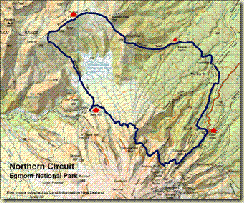
mt_taranaki_northern_circuit_Map1

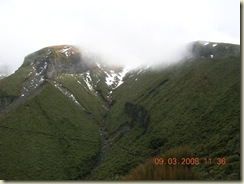
Just came back from a tramping trip with Jack and Harold from the Pouakai Circuit in Taranaki, "leaving nothing but footprints and bringing back nothing but memories". Here are some photos to do the story-telling.

We started off at 3am in the morning, driving for five hours at SH3 to New Plymouth, had pies and coffee at a cafe nearby (which is surprisingly run by a Thai Chinese in the remoteness of NZ). Then we rushed to the North Egmont Visitor's Centre to start the track as early as possible.
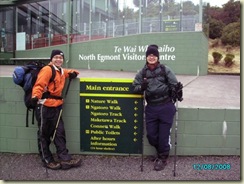
Taranaki 1

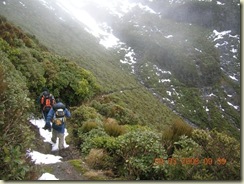
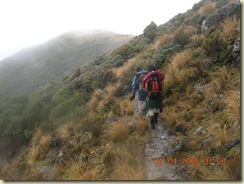
We then head off the Holly Hut track about 11am. It was quite a challenge to climb up the stairway as we took a lot of time stopping to catch some breath. But once we've climbed beyond the bushline, the views of the Razorback is just amazing, as we tread along the ridge. Some of the path is covered with snow, and it was misty.
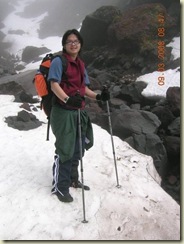
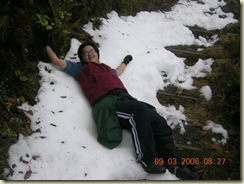
Crossing Icy Land Slip

Lying down on the icebed

Nice glacier-like formations

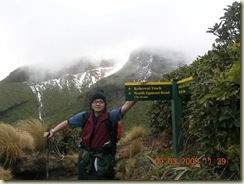
At a junction with well-marked DOC directions

Jack and I

The route has some patches of melting ice

It was quite a challenging walk for Harold and Jack. Its the first time Jack's tramping and Harold being a paranoid person, was sometimes overwhelm with fear especially crossing some rocky terrains and the notoriously loose sandy slip, named Boomerang Slip. The slip is a result of erosion from the previous volcanic lava flow.
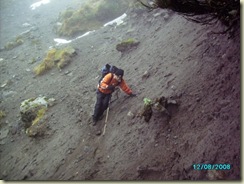
Harold carefully treading the sandy and steep slip, sometimes trying to gain balance.

I was glad that I bought the $40 walking pole which helped me balance and tread challenging terrains, besides protecting my knees from too much impact.

Instead of the three hour walk estimated by the Department of Conservation, we took about 5.5 hours to reach Holly Hut. The hut is a simple 32-bunk hut with solar powered lighting and fireplace heating. There was no one there so we got the whole place to ourselves. We couldn't start the fire despite frail attempts by Jack.(Hover mouse on the pics for descriptions)
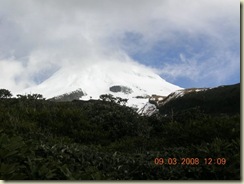
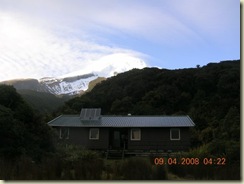
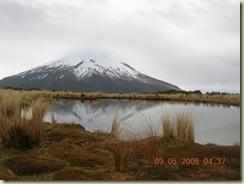
Some glimpse of Taranaki. To get a full view of Taranaki without the clouds is a jackpot. After 5.5 hours of trodding with heavy backpacks, we reached Holly Hut, with great views of the Naki. It has some basic mattress and fireplace. But we couldn't start any fire because we don't have fuel. My dress makes me look baggy and fat compared to Harold and Jack

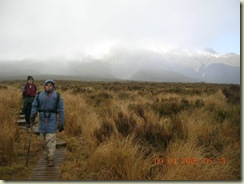
The next day, we continued the journey to Pouakai Hut in the Pouakai Ranges. This time it only took us 3 hours to reach the hut, crossing the wet Ahukawakawa swamp, with lovely yellow tussocks
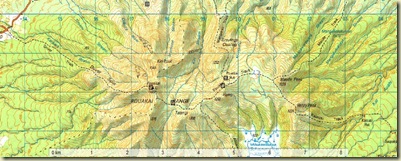
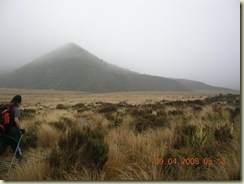
Pouakai-map

Passing through the golden tussocks

Boardways along the wet track

n668815201_1744952_5628

Some cool pose for Facebook profile pic

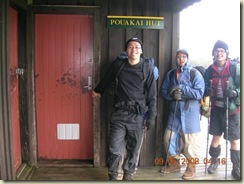
We reached Pouakai Hut by 3 hours. Its a much smaller hut but nicely located to have a gorgeous view of the Pouakai Range and a spectacular view of the Taranaki.
n668815201_1744959_8009

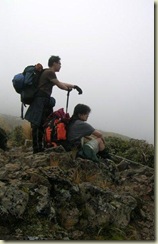
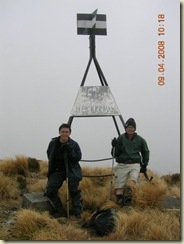
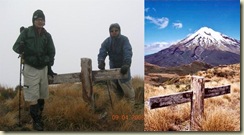
After putting our bags down, we rested for a while before heading up to the Pouakai Peak another good three hours away as a side trip, having a good hot cup of tea on the peak, 1400m elevation from sea level. Unfortunately the views at the peak was disappointing due to the thick clouds. What a stark comparison between the artist's impression and the real thing!
n668815201_1744954_6309

n668815201_1744955_6661

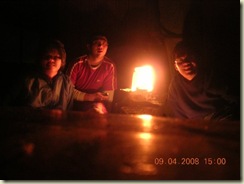
Much to our delight, there's a pile of newspaper in the hut which we used as fuel to start burning the wood and coal at the fireplace. The luxury of heat is much welcomed in the coldness of the highlands, but the heat did not last long beyond few hours after we went to bed. All of us couldn't sleep after the last coal turned into ash, due to the piercing coldness of the Taranaki air.
n668815201_1744958_7671

The final day has come. We were told that if it rains heavily the streams of the Kaiauai track may be flooded making them impossible to pass. We were told to be ready to stay for another night or to turn back the way we come from (which is 8-10 hours long!) should the streams be flooded.

When leaving the hut, we managed to took some lovely last snaps of the Taranaki.
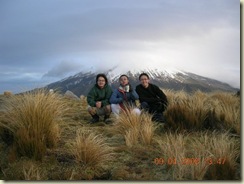
Lovely colours in combination

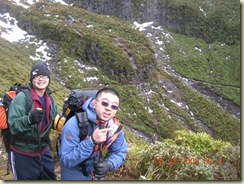
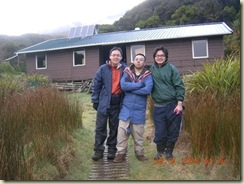
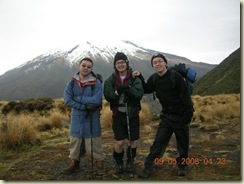
Three Random Asians

n668815201_1744961_8734

The Kaiauai track involves climbing 2 peaks, Maude and Henry and a sharp descent down into the forest before crossing four streams and a swingbridge before ending the whole track. Before the upgrading of the track few years ago, it was described by an earlier tramper
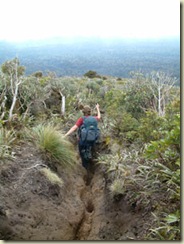
henry

"Descending 460m in only 1.3 km, the first 60m lures you into a false sense of security as the wooden steps continue - then they end and, for 400m descent, the track becomes a rutted, twisted muddy erosion gully, at times more than waste deep and ony one footwidth wide at the base as it plunges through the dense leatherwood scrub, then the moss- and fern-covered twisted tree trunks of the "goblin" forest zone, and finally into taller fern-filled cloud forest of kamahi and totara."

We are glad that the track was upgraded thanks to the Taranaki Savings Bank (TSB) Community Trust for donating $150 000 to lay down boardways along the way as part of the upgrading program, sparing us from the mud hell.

The descent then led us to the subalpine "goblin" forest with some kamahis. Looks quite Narnia-ish, says Harold.
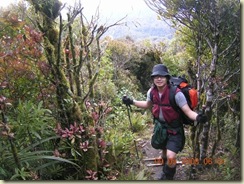
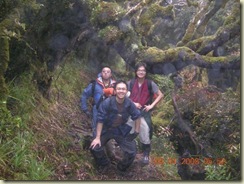
n668815201_1744968_1147

n668815201_1744949_4611

Apparently we were told that the forest has some evil carnivorous flesh eating giant snails, Powelliphanta annectens that can eat up cows and even elephants! They might be cousins with the Malaysian leeches.

Flesh eating snails

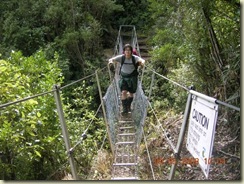
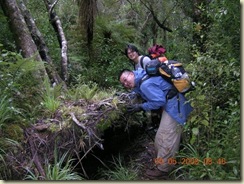
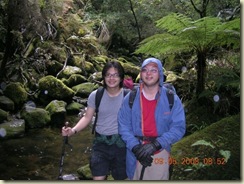
The ubiquitous trees all around reminded me of the Malaysian rainforest, boring us. Thus sights like this uprooted tree is a unusual variety. Some of the river crossings are evil, going down the steep river banks and climbing them up again, through the tree roots and many ladders. At least when we get arthritis at older age, we know where to blame. The swing bridge at the end of the track finally was kinda the finale, ending our 7 hour long ordeal, despite another 40 minute walk up to the carpark.
n668815201_1744971_2296

stream crossing

n668815201_1744974_3442

Tired, aching yet satisfied, we left Taranaki without a full view of the peak due to the constant clouds surrounding it. Thus I guess we had to be make do with a postcard photo. But at least we had done pretty well by finishing the overnight tramp, earning some bragging points and certainly a NZ tramping experience worth dying for.

Jawi

jawi

jawi3

[Updated : Kedah MB defends usage of Jawi, which stupid Kedahan MCA politicians assumed as religious fundamentalism. He said, "I personally like the Jawi script. It is artistic. We have to defend our heritage"]

I share Faisal Tehrani's disappointment with Teresa and DAP in general, whom expressed ignorance to the Jawi script, a precious Malaysian heritage since times of the Terengganu Batu Bersurat 1303AD and the Malay Malaccan and Johorean Sultanate in the 17th century.

Jawi script, while being an adapted Arabic alphabet for spoken Malay, existed in the Nusantara for many centuries as the Nusantaran tradition evolved from an oral to a written one. While it has its roots from the middle east, it is not Arabic nor a product of 20th century Arabisation. One who claims to understand and represent the Malaysian society carefully should be observant enough to differentiate this distinction.

Only after the arrival of the Jawi script, which become a form of the Malay heritage (together with the Malay Sultanate, language and culture), came European as well as Chinese and Indian languages which added up to the cultural diversity. During pre-independence, Jawi is the script for official documents in the British colonial government and the Sultanate alongside English. During independence, the Malay sultanate, language and official religion is acknowledged in the the constitution with acceptance of a free citizenship to all residents of Malaya.

Sadly what little national heritage we have left, is being politicised by some quarters to gain popularity. Instead of trying to appreciate the culture, language and heritage of the land and the Malay culture it has shaped, we forgo history, in the name of pragmatism and our own brand of the so-called 'multiculturalism'. To claim multiculturalism while abandoning indigenous heritage is totally absurd. The Malay language is both expressed in romanised and arabised scripts.

We can raise the question, why don't we include the Mandarin and Tamil script in our road signs since it reflects the demography of the local community? Then why don't we include Thai, Iban, Penan or even Urdu for 'multiculturalism' sake, to be so-called more 'inclusive'? Even if there are many who can't read Jawi, what's the proportion of people who can read other scripts anyway? Since many people can read English, why not just turn all the road signs to English for the sake of its utility?

Without this Malay construct as the backbone of society, Malaysia is not what she was, what she is and what she will be in the future. Only with this construct, in engagement with minority and emerging cultures, we seek a meaningful common vision for a unified society shaped by the values of the people Malaysia represents. A bangsa Malaysia without the Malay heritage is something that I do not look forward to.

I am not against efforts of reconciliation and intercultural understanding, but to sideline the national heritage in vain attempts of gaining narrow communal political score is just appalling.

A nation without a soul, the Malay soul as the basis of the common heritage and identity, will leave us soulless and cold, in the prison of pragmatism, blown by whatever wind of the day.

Bahasa Jiwa Bangsa