Government has made salary adjustments since 1992
By MERGAWATI ZULFAKAR
The Star
PUTRAJAYA: No salary revision for now.
Prime Minister Datuk Seri Abdullah Ahmad Badawi said the Government was not prepared to consider the request for a salary revision for those in the support categories of the civil service and police personnel.
He said that if a salary review were done, it would involve the 1.1 million civil servants and 85,000 members of the police force, and this would cost an additional RM6bil.
“We have discussed their demands. At the moment, the Government is not ready to spend so much money. We need to take into account the government's finances because we need to spend money on development,” said Abdullah.
“The people need development. We cannot just say the Government does not have the money because it has gone to pay salaries,” he told a press conference after chairing a Cabinet committee meeting on posts and salaries of the civil service here yesterday. Also present was Housing and Local Government Minister Datuk Seri Ong Ka Ting.
Read more
Friday, September 29, 2006


Thursday, September 28, 2006
Don't Put God in a Box
http://str.typepad.com/weblog/2006/06/dont_put_god_in.html
"Don't Put God in a Box."
Can we all agree to never use this sentence again? It's an unproductive ad hominem thrown into a potentially productive conversation about understanding God.
I've heard it as the answer to a creationist who thinks God could not have designed using the random mechanism of evolution. I've heard this phrase tossed out after a long Biblical rationale for why God doesn't give personal, specific direction as in "God speaks to me." I've heard it as the only rejoinder when someone explains why they don't believe in charismatic gifts today. I've heard it as the only response after an explanation for why Calvinism is the best systematic understanding of the Bible. I've heard it from Christians as the alternative to the Bible is our sole source of religious authority.
"Don't put God in a box."
What I think that line really means is, "I don't agree with your explanation but I don't have an argument in response." It's a way of dismissing someone's reasons without saying why they're wrong.
And it's actually kind of rude because it implies that we're doing something illegitimate with God. But you know what? We all put God in a box - the box being how we best understand God's revelation of Himself in Scripture. The box is one of God's own nature we're all just trying to figure out what the box looks like.
God should be in a box. What's the alternative? God has no limitations on what He can be like or act like? That is frightening. God Himself is limited by His own nature. He can't lie. He can't sin. He's can't go out of existence. God's box - the definition of what He is like - is what makes Him God and a Person we can love and trust and glorify. If God isn't in some kind of a box, He would be arbitrary.
God's box is the biggest and greatest box there is. He's omniscient - He knows and believes all true things; but He cannot believe false things. He's omnipotent - God can do whatever power can do. His potentialities are at the greatest limit of the attributes He possesses. But those very attributes define Him, they describe His box. Our goal is to get the best idea of what that box looks like.
"Don't Put God in a Box."
Can we all agree to never use this sentence again? It's an unproductive ad hominem thrown into a potentially productive conversation about understanding God.
I've heard it as the answer to a creationist who thinks God could not have designed using the random mechanism of evolution. I've heard this phrase tossed out after a long Biblical rationale for why God doesn't give personal, specific direction as in "God speaks to me." I've heard it as the only rejoinder when someone explains why they don't believe in charismatic gifts today. I've heard it as the only response after an explanation for why Calvinism is the best systematic understanding of the Bible. I've heard it from Christians as the alternative to the Bible is our sole source of religious authority.
"Don't put God in a box."
What I think that line really means is, "I don't agree with your explanation but I don't have an argument in response." It's a way of dismissing someone's reasons without saying why they're wrong.
And it's actually kind of rude because it implies that we're doing something illegitimate with God. But you know what? We all put God in a box - the box being how we best understand God's revelation of Himself in Scripture. The box is one of God's own nature we're all just trying to figure out what the box looks like.
God should be in a box. What's the alternative? God has no limitations on what He can be like or act like? That is frightening. God Himself is limited by His own nature. He can't lie. He can't sin. He's can't go out of existence. God's box - the definition of what He is like - is what makes Him God and a Person we can love and trust and glorify. If God isn't in some kind of a box, He would be arbitrary.
God's box is the biggest and greatest box there is. He's omniscient - He knows and believes all true things; but He cannot believe false things. He's omnipotent - God can do whatever power can do. His potentialities are at the greatest limit of the attributes He possesses. But those very attributes define Him, they describe His box. Our goal is to get the best idea of what that box looks like.
Wednesday, September 27, 2006
Why philosophize?
from SzeZeng
"The word 'heresy' not only means no longer being wrong; it practically means being clear-headed and courageous. The word 'orthodoxy' not only no longer means being right; it practically means being wrong. All this can mean one thing, and one thing only. It means that people care less for whether they are philosophically right." - G.K Chesterton, Heretics
"To be ignorant and simple now --not to be able to meet the enemies on their own ground --would be to throw down our weapons, and to betray our uneducated brethren who have, under God, no defence but us against the intellectual attacks of the heathen. Good philosophy must exist, if for no other reason, because bad philosophy needs to be answered..." - C.S Lewis, The Weight of Glory
"The word 'heresy' not only means no longer being wrong; it practically means being clear-headed and courageous. The word 'orthodoxy' not only no longer means being right; it practically means being wrong. All this can mean one thing, and one thing only. It means that people care less for whether they are philosophically right." - G.K Chesterton, Heretics
"To be ignorant and simple now --not to be able to meet the enemies on their own ground --would be to throw down our weapons, and to betray our uneducated brethren who have, under God, no defence but us against the intellectual attacks of the heathen. Good philosophy must exist, if for no other reason, because bad philosophy needs to be answered..." - C.S Lewis, The Weight of Glory
Monday, September 25, 2006

Saturday, September 23, 2006
Relativism
For the past 2 days I had been engaging in a bit sort of a intellectual philosophical dialogue in persuasion in pointing out the human need for God to make sense out of life. It has been stimulating and I pray that in the midst of all the ramblings of the mind, God will open my spiritual eyes and the eyes of my friends to see His truth in the midst of the marketplace of ideas.
Many a times I faced with this statement, "What is correct for you is not correct for me. It is all relative. There is no clear definition of correctness." In combatting that, I gave 3 theses.
a) Every human being has a common moral conscience that leads them to desire goodness, perfection, beauty, justice and perhaps a utopian world. This shows that human beings are made in the image of God who is perfect, beautiful and just.
b) If there is no absolute truth, then all truth is worthless. There is no point learning about something to realise that it is not true at the end of it. Ravi Zacharias once said, modern education produces graduates who believe in nothing!
c) The natural law. There are some laws in the world that cannot be changed. Some people further suggested that there is natural moral law. Is the sky blue? Can human body fly? Where do small babies learn about the concept of justice and fairness they fight for toys?
d) Social Darwinism. Relativism gives rise to equality and allow people to do whatever that 'feels good' and 'feels right to them'. If I can believe it wrong for me to harm others, I can also believe it right — no matter what the circumstances.
Wikipedia proposes few more arguments, which I will need some more time to digest. The Catholic Church seems to provide quite a satisfying answer in debunking relativism. Wikipedia says that,
Relativism, orthodox Catholics say, constitutes a denial of the capacity of the human mind and reason to arrive at truth. Truth, according to Catholic theologians and philosophers (following Aristotle and Plato) consists of adequatio rei et intellectus, the correspondence of the mind and reality. Another way of putting it states that the mind has the same form as reality. This means when the form of the computer in front of me (the type, color, shape, capacity, etc.) is also the form that is in my mind, then what I know is true because my mind corresponds to objective reality.
Relativism, according to the Catholic and Aristotelian viewpoint, violates the philosophical principle of non-contradiction, a most fundamental principle of all thinking, and without which humans have no way to understand each other nor any possibility of science (emphasis mine)
The denial of an absolute reference denies God, who equates to Absolute Truth, according to these Christian philosophers. Thus, they say, relativism links to secularism, an obstruction of God in human life.
It is interesting to note that the pursuit of science is very much based on objectivity and gives no room for relativistic natural laws which govern our surroundings. Without objectivity in our worldview, I believe that we will never be able to make sense out of the bits of the world we live in as we will always be trying to reconcile different worldviews, which may not at the first place, at par with each other.
The pope also said something very interesting during the World Youth Day, warning against human agenda in absolutizing things that are relative, and relativising things that are absolute. He warns against absolutising relativistic human ideas, which leads to enslavement, and asserts that only the living God promises absoluteness of what is really good and true.
"In the last century we experienced revolutions with a common programme – expecting nothing more from God, they assumed total responsibility for the cause of the world in order to change it. And this, as we saw, meant that a human and partial point of view was always taken as an absolute guiding principle. Absolutizing what is not absolute but relative is called totalitarianism. It does not liberate man, but takes away his dignity and enslaves him. It is not ideologies that save the world, but only a return to the living God, our Creator, the guarantor of our freedom, the guarantor of what is really good and true."
Many a times I faced with this statement, "What is correct for you is not correct for me. It is all relative. There is no clear definition of correctness." In combatting that, I gave 3 theses.
a) Every human being has a common moral conscience that leads them to desire goodness, perfection, beauty, justice and perhaps a utopian world. This shows that human beings are made in the image of God who is perfect, beautiful and just.
b) If there is no absolute truth, then all truth is worthless. There is no point learning about something to realise that it is not true at the end of it. Ravi Zacharias once said, modern education produces graduates who believe in nothing!
c) The natural law. There are some laws in the world that cannot be changed. Some people further suggested that there is natural moral law. Is the sky blue? Can human body fly? Where do small babies learn about the concept of justice and fairness they fight for toys?
d) Social Darwinism. Relativism gives rise to equality and allow people to do whatever that 'feels good' and 'feels right to them'. If I can believe it wrong for me to harm others, I can also believe it right — no matter what the circumstances.
Wikipedia proposes few more arguments, which I will need some more time to digest. The Catholic Church seems to provide quite a satisfying answer in debunking relativism. Wikipedia says that,
Relativism, orthodox Catholics say, constitutes a denial of the capacity of the human mind and reason to arrive at truth. Truth, according to Catholic theologians and philosophers (following Aristotle and Plato) consists of adequatio rei et intellectus, the correspondence of the mind and reality. Another way of putting it states that the mind has the same form as reality. This means when the form of the computer in front of me (the type, color, shape, capacity, etc.) is also the form that is in my mind, then what I know is true because my mind corresponds to objective reality.
Relativism, according to the Catholic and Aristotelian viewpoint, violates the philosophical principle of non-contradiction, a most fundamental principle of all thinking, and without which humans have no way to understand each other nor any possibility of science (emphasis mine)
The denial of an absolute reference denies God, who equates to Absolute Truth, according to these Christian philosophers. Thus, they say, relativism links to secularism, an obstruction of God in human life.
It is interesting to note that the pursuit of science is very much based on objectivity and gives no room for relativistic natural laws which govern our surroundings. Without objectivity in our worldview, I believe that we will never be able to make sense out of the bits of the world we live in as we will always be trying to reconcile different worldviews, which may not at the first place, at par with each other.
The pope also said something very interesting during the World Youth Day, warning against human agenda in absolutizing things that are relative, and relativising things that are absolute. He warns against absolutising relativistic human ideas, which leads to enslavement, and asserts that only the living God promises absoluteness of what is really good and true.
"In the last century we experienced revolutions with a common programme – expecting nothing more from God, they assumed total responsibility for the cause of the world in order to change it. And this, as we saw, meant that a human and partial point of view was always taken as an absolute guiding principle. Absolutizing what is not absolute but relative is called totalitarianism. It does not liberate man, but takes away his dignity and enslaves him. It is not ideologies that save the world, but only a return to the living God, our Creator, the guarantor of our freedom, the guarantor of what is really good and true."
Creeds & Confessions
Excerpt from Dave Chang, Icon of Nicene Creed is from Wikipedia, Emphasis mine
 To ignore creeds and confessions is the height of modern arrogance . Simply because we have microwaves and Novocain, we assume that ours is the wisest, most self-sufficient age in history. And yet, technological sophistication does not equal wisdom; know-how is not the same as knowledge.
Christians have fallen into this modern arrogance by assuming that they do not need the teachers that Paul commended to Timothy. Nor do they need catechetical instruction. 'I just believe the Bible' is no defense against cults, superstitions, apostasy, and heresy, since nearly every sect for the last two thousand years has claimed the Bible for support.
The answer is not to make the church's teachers infallible interpreters of Scripture, as in Rome, nor to ignore the church's teachers, as in contemporary evangelicalism, but to have the humility to recognize that 'iron sharpens iron' and that it takes the wisdom and insight of many interpreters over many centuries to help us to see our blind spots. Only a fool would ignore the accumulated wisdom of nearly twenty centuries.
Are the creeds infallible? No, but the universal confession of the whole church since its beginning, despite other divisions, is that the Bible clearly teaches that the affirmations we find in the Apostles', Nicene, Chalcedonian, and Athanasian creeds are essential for our salvation .
Protestants, Catholics, and Orthodox believers are united in their commitment to these essentials . They are not true because the church says so; the church says so because they are true.
The tradition of calling the universal church for a council began among the apostles themselves, with the Council of Jerusalem, to combat the Judaizing heresy (Check in the book of Acts). While councils may err and have erred to the point of even contradicting each other in the middle ages, the early ecumenical councils carry the assent of all Christians everywhere and have right up to the present.
Why should we tolerate as shepherds among us anyone whose teaching fails to conform to the clear consensus of the whole Christian church from its earliest days?
 To ignore creeds and confessions is the height of modern arrogance . Simply because we have microwaves and Novocain, we assume that ours is the wisest, most self-sufficient age in history. And yet, technological sophistication does not equal wisdom; know-how is not the same as knowledge.
Christians have fallen into this modern arrogance by assuming that they do not need the teachers that Paul commended to Timothy. Nor do they need catechetical instruction. 'I just believe the Bible' is no defense against cults, superstitions, apostasy, and heresy, since nearly every sect for the last two thousand years has claimed the Bible for support.
The answer is not to make the church's teachers infallible interpreters of Scripture, as in Rome, nor to ignore the church's teachers, as in contemporary evangelicalism, but to have the humility to recognize that 'iron sharpens iron' and that it takes the wisdom and insight of many interpreters over many centuries to help us to see our blind spots. Only a fool would ignore the accumulated wisdom of nearly twenty centuries.
Are the creeds infallible? No, but the universal confession of the whole church since its beginning, despite other divisions, is that the Bible clearly teaches that the affirmations we find in the Apostles', Nicene, Chalcedonian, and Athanasian creeds are essential for our salvation .
Protestants, Catholics, and Orthodox believers are united in their commitment to these essentials . They are not true because the church says so; the church says so because they are true.
The tradition of calling the universal church for a council began among the apostles themselves, with the Council of Jerusalem, to combat the Judaizing heresy (Check in the book of Acts). While councils may err and have erred to the point of even contradicting each other in the middle ages, the early ecumenical councils carry the assent of all Christians everywhere and have right up to the present.
Why should we tolerate as shepherds among us anyone whose teaching fails to conform to the clear consensus of the whole Christian church from its earliest days?
Friday, September 15, 2006
Faith and Doubt

"If ours is an examined faith, we should be unafraid to doubt... There is no believing without some doubting, and believing is all the stronger for understanding and resolving doubt".
Os Guinness, God in the Dark
"God doesn't give us all the faith to 100% believe in Him. Instead, he give us just enough faith for us to believe and also to disbelieve. Therefore, it is a choice for us to respond to the truth, and this choice makes us responsible for our eternal destiny"
paraphrase from Jimi Goh, Manipal Medical College
"Godliness doesn't mean that we blindly accept the set of beliefs that we are given, but it is a slow struggle to make sense out of God, the scriptures and the life we live in. Doubting is not certainly not wrong."
paraphrase from Linda Chew, International Medical University
Tuesday, September 12, 2006
Socioeconomic Disparity in the Church
Recently I was astounded to see such stark socioeconomic difference in the Church.
Maverick in his blog posted:
Maverick in his blog posted:

"Why does a church wants to spent $100 million just to built a convention center?
That money can be used for uplifting the lifes of those in destitute conditions.
Afterall, church's money are from it's members' altruistic intend and wouldn't it be far effective to uplift the lives of those in dire straits and those destitute?"
Bob Kee too...
"All I can say is that I can totally appreciate the feelings of irony and probably outrage at this blatant display of material one-uppance....
While churches in the Klang Valley seek to spend tens and hundreds of millions in building projects, our fellow brothers and sisters in other parts of the country worship in buildings that many of us wouldn't even use as living quarters, let alone a place of worship. Couple this with the fact that for many of these communities, jobs are hard to come by and basic necessities like food, clean water and even a viable education is so hard to come by, I really wonder why we take pride in our edifices of concrete, chrome and glass?"
Few hundred kilometres away across the sea in Sabah, Rev. Anthony Siew lamented,
"I still feel very sad that very little has been done to alleviate the sufferings and poverty of many of my denomination’s full-time workers. Some heart-searching statistics - Less than 20% own cars. 80% earn less than US 200.00 a month (RM 750.00 p.m.). Nearly 50% drop out of the ministry within the first three years of pastorate and mainly due to financial hardships. Even most city churches’ pastors are paid about US$300.00 per month. The cost of living in Kota Kinabalu is at least US$ 500.00 per month for a pastor with a young family.
Less than 30% continue to serve when they reach 40 years old, hence very few senior pastors in my denomination. Why? Once the pastors’ children reach secondary school age, most pastors could not support their children’s schooling with their meager income."
.......................................................................
Until we can look beyond the 4 walls of our "convention centres" and give beyond the "building-fund pledge cards", the only thing I can do is to pray. It seems to me that cell groups buffets will continue in the midst of 50cents nasi-lemak fellowships in the Malaysian church.
Monday, September 11, 2006
The Mrs. Jesus Controversy
Of Helen Clark, K Road and Celibate Priests; a Biblical Analysis on Mary Magdalene and Jesus Christ as Portrayed in the Da Vinci Code.
by WEE Choon Wei
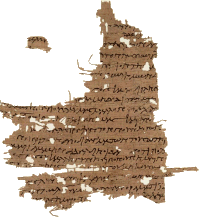
Gnostic Gospel of Mary Magdalene
The enormously popular Da Vinci Code, by Dan Brown in 2003 had captivated and brought a new phenomenon of spiritual interest amongst the masses. Hitting the 40million sales record worldwide and topping the charts of local New Zealand bookstores (Calvert-Koyzis, 2006; Tunnah, 2004), the mass media portrayal seems to imply that the novel is historically and factually accurate, thus encouraging an uncritical acceptance of popular ideas of the person of Mary Magdalene. Interestingly, the theory behind the novel draws inspiration from the earlier Holy Blood, Holy Grail, published in 1982 that was co-authored by a New Zealand-born author Michael Baigent. For the first time in the 21st century, issues of faith and biblical tradition had attracted such great interest in an egalitarian post-Christian New Zealand society.
Read More
by WEE Choon Wei
Gnostic Gospel of Mary Magdalene
The enormously popular Da Vinci Code, by Dan Brown in 2003 had captivated and brought a new phenomenon of spiritual interest amongst the masses. Hitting the 40million sales record worldwide and topping the charts of local New Zealand bookstores (Calvert-Koyzis, 2006; Tunnah, 2004), the mass media portrayal seems to imply that the novel is historically and factually accurate, thus encouraging an uncritical acceptance of popular ideas of the person of Mary Magdalene. Interestingly, the theory behind the novel draws inspiration from the earlier Holy Blood, Holy Grail, published in 1982 that was co-authored by a New Zealand-born author Michael Baigent. For the first time in the 21st century, issues of faith and biblical tradition had attracted such great interest in an egalitarian post-Christian New Zealand society.
Read More
Saturday, September 09, 2006
John Calvin - Father of the Reformed Faith

John Calvin
Father of the Reformed Faith
In my Bijisawi blog, I posted my quiz result "Which theologian are you?" and I got John Calvin. I am pretty much influenced by his theology which I collected from my upbringing in Air Jernih Presbyterian Church, Kuala Terengganu. Although there is no explicit teaching on the Institutes of the Christian Religion, or Calvinistic Theology, the conversations on the understanding of God, human nature, salvation and church government, in my home church is very much influenced by John Calvin.
Only in this year I managed to learn more about John Calvin, the Puritan Movement, John Knox, George Whitefield, Johnathan Edwards, Karl Barth and John Piper. Thanks to the Agora, Microsoft Encarta, Wikipedia, Hsen Han and Tania for sparking this interest in me to learn more. Though my understanding of Calvin's teaching is still very limited apart from the 5 solas, predestination and the tension with Arminianism, this article from CT is very interesting and informative. Read more
Sunday, September 03, 2006
Of kafirs, buffets and lion dance - a Malaysian Christian reflection
31st August marks another year for our nation to celebrate her 49th birthday. It is a celebration of independence, a celebration of national dignity and a celebration of growth from a helpless state terrorized by communism to one of the most advanced developing nations in the 21st century. Much had been achieved over the decades and today, Malaysia is the home of 25million people, of which 10% claims to be follower of Christ. From the early days of church planting and reaching the indigenous by Western missionaries, the church of Malaysia has grown to maturity with indigenous leadership, learning to be self-sufficient and self-propagating. It has gone through various challenges and changes throughout the decades, and increasingly becoming a blessing for the nation and a player in reaching the world for Jesus Christ.
After many years of being a Christian since my conversion, and living in a multiracial and multi religious society as a minority, with a new identity of being “anak Malaysia”. Born into a middle Class Chinese family, knowing little Mandarin, having English as my ‘first’ language, deemed as one of the kafir dhimmi variety in Muslim dominated Terengganu, interacting with my fellow Malay and Indian brothers, watching MTV and Wah Loi Toi on Astro, singing hymns and sitting on pews, jumping up and down in Planet Shaker’s conferences, adoring John Stott and the Pope, reading the success stories of Rick Warren and Yonggi Cho and going to mamak at the end of the church youth service. What does it mean to be a Malaysian Christian?
Who are we? Why are we here? Where are we heading to? Here are some thoughts of which I would like to put forward even as we make sense of our calling in this nation.
Firstly, it means that we are the co-heirs of this nation. The founding fathers of the nation had maintained that it is a country founded by mutual cooperation between races in the country through the Social Contract. While Islam is the religion of the constitution, the constitution guarantees equal rights as citizens to profess our religion and protection by the law. It is through power sharing that each of the different groups has a say and a choice in determining our future. We are not the underclass that exists by the mercy of others, but we are equal co-heirs of the future that is awaiting us. God has already chosen us to be His people and places us in this nation to shine His glory in this nation. Therefore as Christians, we are to contribute to the political, social and economic prosperity of our country. Living holy Christian lives within the ‘holy cuddle’ of the church community will be like living as a hermit in the caves, acquiring divine enlightenment, but not being able to pass it on to others. Instead we are to take up the call God has said in Jeremiah 29:7 “Work for the good of the cities where I have made you go as prisoners. Pray to me on their behalf, because if they are prosperous, you will be prosperous too.” We certainly need to exercise our democratic rights and to voice out our stand for Christ in matters of national interest. We also need to be actively involved in nation-building and social services in the name of Christ. Too many Christians today shun the education system, the civil and military services, without taking consideration to penetrate into the system and transform it for Christ. The cost of transforming the nation for Christ is not cheap. It calls for more Christians are to take up the call to serve God selflessly in areas where there is no Christian witness, no matter how hostile it may be. It is the call to redefine the “Kuala Lumpur Dream”.
Secondly it means that we are to be the witness for Christ in this nation. The Bible says that we are the royal priesthood, the holy nation who is set apart to proclaim the Kingdom of God (1 Pet 2:9). As the full consummation of His kingdom is yet to be fulfilled by His second coming, we are to preach the good news of Jesus Christ wherever we are including this country. It is His will that none should perish but all to be brought into His saving knowledge. Therefore, the calling is great and we have much to do in terms of reaching this nation! We need grow in evangelism and missions, to pay up the debt of the cross from the early missionaries by passing it on to those who have never met the reality of Jesus Christ. To proclaim the Word of God to every man is not an option, instead it is a command and the central theme of the whole Gospel and the Evangelical faith. Failure to live up to this calling I believe is the failure for us to grasp the central message of Christ’s mission to reconcile men with God. In the midst of our effort to dialogue with other faiths and worldviews, we need not water down the urgency for us to preach the Gospel and persuade both ‘the wise and the foolish’ to faith (Rom 1:14). We need to feel God’s sorrow for the sin of humanity, the physical and spiritual death it brings, and realize that righteousness comes from faith in Jesus Christ alone. Dr. Ng Kam Weng once proposed, for genuine interaction with pre-believers using truth, love and supernatural encounters as the reality of God.
Thirdly it means that we are to embrace the prophetic vision for this nation. We are to be a prophetic community in this 21st century that defies the odds of the day of which Ravi Zacharias described as “secularization, privatization and relativistism”. Secularism has created a void, which Blaisé Pascal described as “a God-shaped hole”. Privatization at the other hand has reduced faith as something personal and subjective, which has nothing to do with public life. Relativism, at its worst asserts no absolute truth, inherently denying the supremacy and exclusivity of Jesus Christ at the only way! Therefore we are to be a community that seeks to fill the spiritual gap of which secularism cannot fill. In a world of materialism, we are to be a community that values human dignity and worth as individuals created in God’s image. We are to be a community that portrays love. We are to be a community that radically engages with the culture and problems of the day in light of Biblical truths. Malaysian Christians, in my opinion should be the ones who live in simplicity in the midst of a greedy and ‘kiasu’ society. We should be the ones who publicly oppose ungodly values of our society such as corruption, social inequality between the rich and the poor, crime and sexual immorality. Like John the Baptist, we should be the “voice calling out from the wilderness” (Lk 3:4), calling the nation back to righteousness, which ultimately comes from Christ alone.
Fourthly, we are to be the Good Samaritans in our country. We need to be the ones who cry out for the poor, for the weak, for the marginalized. (Isaiah 61). We need to take our privileges and resources that God has entrusted us with to bless those who are underprivileged. James 1:27 says that “pure and genuine religion is this: to take care of orphans and widows in their suffering…” Though we are small, we have our part to play to portray the love of Christ in concrete actions to the weak and helpless. If we are unable to do so, then all our faith and the gospel that we preach, as described by 1 Corinthians 13, will be of no value. Our witness will not be effective if our own personal and corporate life do not show compassion and love, and the willingness to dirty our hands for those who are less fortunate than us. The Bible has clearly shown that God’s heart is for the poor, and if we are to be a generation “after God’s own heart”, then we ought to be a generation that cares for the poor. Our concern for the poor must not be made one of the many aspects of Christian discipleship, but it is our Father’s business as important as the verbal proclamation of the Word of God. If Jesus Christ is to be with us today, He will rather be playing congkak at the slums of Kampung Medan than playing golf. He will be distributing food for the hungry than having buffet meals for every Cell Group meeting. He will be at the back alleys of Chow Kit with the homeless, rather than in our air-conditioned, queen-sized bed youth camps singing endless songs which leads nowhere.
Fifthly we are to be the guardian of our culture. History has shown that Christianity is not an European religion, but an Asian one from the Middle East. The fact that today people from many tribes and tongues profess to believe in Jesus Christ proves the fact that it is universal. There was once a saying that goes “Another Christian means one less Chinese”. This statement is sad but true as many of us still live an Orang Putih version of Christianity. Many Christians today, coming from Asian background distance themselves from the culture that they come from. In the midst of globalization and erosion of traditional values which one way can be attributed to increasingly popular MTV culture, we need to be the people who are more ‘Asian’ than non-Christian! We need to be even more passionate for our own cultural identity than any other people, because the Gospel of Jesus Christ can only be made complete when it is totally relevant and meaningful to the culture that one comes from. We need to rediscover our cultural uniqueness and express the Christian faith in our local cultural experience.
Therefore, our Christian ritual and practices need to be reevaluated and redesigned to reflect our Asian identity. One of the ways the local culture has been expressed in Asian Christianity is the beautiful usage of gamelan and traditional dances by the Church of Bali in their worship, and their beautiful Balinese architecture in church buildings. Imagine how glorious it is if the Malaysian Church can tap on the wealth of our multiracial heritage to enrich our church life. With the beautifully sounding gamelan, gong and er-hu, coupled with the elaborate kuda kepang (e.g. Jesus riding the donkey to Jerusalem) and lion dances (e.g. the Lion of Judah), plus the usage of local literary heritage of pantun and syair, without neglecting the modern acoustics and percussions, it is beyond imagination. Let us be the preservers of our cultural tradition so that in the future, Malaysian Christians will be more ‘Malaysian’ than any other ordinary Malaysian.
Sixthly, we are to be the sons of the soil. We are to embrace the Promised Land that God has given to us, the ‘tanah tumpahnya darahku’. Like the Israelites who were promised the land of Canaan, we are the heirs, the future ‘bumiputra’ of the land that God has given to us. Our pilgrim identity as Chinese and Indian immigrating from one country to another, with no motherland should end. As Wong Chun Wai, columnist of the Star boldly stressed, “This is our country, there is no other country”, it is my prayer that Christians of Malaysia can weep for God’s glory to fall on this nation. The rebuke of Joshua in 18:3 rings clear, “How long shall you wait for you to take the land God has given you?” It is not a coincidence that God has placed us in this country for “such as time like this” (Est. 4:14). Thus this calling to be Malaysians should be embraced with eagerness to sing the glorious chorus of “Malaysia bagi Kemuliaan-Mu”. It may not be an easy for some, but it was not an easy experience for the Israelites in Canaan either. But they persevere with hope in their God Jehovah who made a covenant with them, and anticipate for the future glory that comes through the Messiah. Let us then set our eyes on Jesus, the Lord of Malaysia. Let us be known for our patriotism, our dedication to our leaders and our love for peace and prosperity. Let us embrace the history of our country as our own, to weep over the wounds of the past and the present, such the May 13 incident and the ever pressing socioeconomic inequalities. Let us be the loyal ones who will stand together with our fellow Malaysians through thick and thin. Let us put our loyalty on God who entrusts us to be intercessors for this land. It is a God-given honor to be called “anak Malaysia”.
Lastly, we are to be a united community in the midst of diversity. Our nation’s diverse character should be reflected in our churches. We can no longer afford to live within the comfort zone of our racial, cultural and language boundaries, but to actively seek to integrate with other sub-communities within our Christian brotherhood. Although the dismantling of denominational lines is progressing well within the Malaysian Church, there is so much more to do in terms of addressing other unseen differences. We need to rediscover the uniqueness of Bahasa Malaysia as the language of unity and national identity, and should not overemphasize English just for the sake of convenience. Urban middle-class English speaking churches need to be humble to understand the struggles of rural Chinese-speaking churches and East Malaysian BM churches to conform to the over dominance of the English language. By ignoring the unseen lines of linguistic, cultural, or even socioeconomic differences, we are fooling ourselves with a superficial sense of unity. An East Malaysian Christian should not at any point feel that he is a second-class Christian just because he is unable to assimilate well into an English-dominated West Malaysian Christianity. Neither should Mandarin-speaking or Tamil-speaking Christians feel the same. Instead, we need to affirm each other of our partnership in Christ. The English language, that gives economic and educational advantage to many should not be made a stumbling block for some of our ‘weaker’ brothers and sisters to grow in faith. Therefore, as lamented by David Boler, the founding chairman of NECF, Malaysian Christians need to seriously reconsider the status of Bahasa Malaysia in our churches, I believe the national language is the best tool to bridge our differences and to reflect our national identity, despite of how inconvenient it may be. “Read the Bible in Bahasa, sing in Bahasa, pray in Bahasa,” he suggested. Unless and until we do so, we will never face the reality of our own disintegration.
In conclusion, our identity as Malaysian Christians is a unique one as it encompasses various facets of our faith, the culture and the society that we are placed in, in light of the changing world. We are a minority in the Muslim-dominated multireligious society; we are the on-going prophetic community that traces our heritage back to the Judeo-Christian tradition, and also a community which is deeply rooted in our Asian culture and Malaysian society. The social position and cultural richness that we have should be nurtured and celebrated, as it shows off God’s creativity and glory in human society. Even as we remember our 49th year of independence, let us remember that Malaysia is created by God, and we are chosen to part of God’s story to reveal His glory, until He comes again. While we anxiously wait for the new Jerusalem, let us live faithfully to the calling that God has placed upon our “anak Malaysia” generation; to be the salt and light of the nation, and to proclaim the glorious revelation of the resurrected Christ. Maranatha!
Malaysia bagi Kemuliaan-Mu
After many years of being a Christian since my conversion, and living in a multiracial and multi religious society as a minority, with a new identity of being “anak Malaysia”. Born into a middle Class Chinese family, knowing little Mandarin, having English as my ‘first’ language, deemed as one of the kafir dhimmi variety in Muslim dominated Terengganu, interacting with my fellow Malay and Indian brothers, watching MTV and Wah Loi Toi on Astro, singing hymns and sitting on pews, jumping up and down in Planet Shaker’s conferences, adoring John Stott and the Pope, reading the success stories of Rick Warren and Yonggi Cho and going to mamak at the end of the church youth service. What does it mean to be a Malaysian Christian?
Who are we? Why are we here? Where are we heading to? Here are some thoughts of which I would like to put forward even as we make sense of our calling in this nation.
Firstly, it means that we are the co-heirs of this nation. The founding fathers of the nation had maintained that it is a country founded by mutual cooperation between races in the country through the Social Contract. While Islam is the religion of the constitution, the constitution guarantees equal rights as citizens to profess our religion and protection by the law. It is through power sharing that each of the different groups has a say and a choice in determining our future. We are not the underclass that exists by the mercy of others, but we are equal co-heirs of the future that is awaiting us. God has already chosen us to be His people and places us in this nation to shine His glory in this nation. Therefore as Christians, we are to contribute to the political, social and economic prosperity of our country. Living holy Christian lives within the ‘holy cuddle’ of the church community will be like living as a hermit in the caves, acquiring divine enlightenment, but not being able to pass it on to others. Instead we are to take up the call God has said in Jeremiah 29:7 “Work for the good of the cities where I have made you go as prisoners. Pray to me on their behalf, because if they are prosperous, you will be prosperous too.” We certainly need to exercise our democratic rights and to voice out our stand for Christ in matters of national interest. We also need to be actively involved in nation-building and social services in the name of Christ. Too many Christians today shun the education system, the civil and military services, without taking consideration to penetrate into the system and transform it for Christ. The cost of transforming the nation for Christ is not cheap. It calls for more Christians are to take up the call to serve God selflessly in areas where there is no Christian witness, no matter how hostile it may be. It is the call to redefine the “Kuala Lumpur Dream”.
Secondly it means that we are to be the witness for Christ in this nation. The Bible says that we are the royal priesthood, the holy nation who is set apart to proclaim the Kingdom of God (1 Pet 2:9). As the full consummation of His kingdom is yet to be fulfilled by His second coming, we are to preach the good news of Jesus Christ wherever we are including this country. It is His will that none should perish but all to be brought into His saving knowledge. Therefore, the calling is great and we have much to do in terms of reaching this nation! We need grow in evangelism and missions, to pay up the debt of the cross from the early missionaries by passing it on to those who have never met the reality of Jesus Christ. To proclaim the Word of God to every man is not an option, instead it is a command and the central theme of the whole Gospel and the Evangelical faith. Failure to live up to this calling I believe is the failure for us to grasp the central message of Christ’s mission to reconcile men with God. In the midst of our effort to dialogue with other faiths and worldviews, we need not water down the urgency for us to preach the Gospel and persuade both ‘the wise and the foolish’ to faith (Rom 1:14). We need to feel God’s sorrow for the sin of humanity, the physical and spiritual death it brings, and realize that righteousness comes from faith in Jesus Christ alone. Dr. Ng Kam Weng once proposed, for genuine interaction with pre-believers using truth, love and supernatural encounters as the reality of God.
Thirdly it means that we are to embrace the prophetic vision for this nation. We are to be a prophetic community in this 21st century that defies the odds of the day of which Ravi Zacharias described as “secularization, privatization and relativistism”. Secularism has created a void, which Blaisé Pascal described as “a God-shaped hole”. Privatization at the other hand has reduced faith as something personal and subjective, which has nothing to do with public life. Relativism, at its worst asserts no absolute truth, inherently denying the supremacy and exclusivity of Jesus Christ at the only way! Therefore we are to be a community that seeks to fill the spiritual gap of which secularism cannot fill. In a world of materialism, we are to be a community that values human dignity and worth as individuals created in God’s image. We are to be a community that portrays love. We are to be a community that radically engages with the culture and problems of the day in light of Biblical truths. Malaysian Christians, in my opinion should be the ones who live in simplicity in the midst of a greedy and ‘kiasu’ society. We should be the ones who publicly oppose ungodly values of our society such as corruption, social inequality between the rich and the poor, crime and sexual immorality. Like John the Baptist, we should be the “voice calling out from the wilderness” (Lk 3:4), calling the nation back to righteousness, which ultimately comes from Christ alone.
Fourthly, we are to be the Good Samaritans in our country. We need to be the ones who cry out for the poor, for the weak, for the marginalized. (Isaiah 61). We need to take our privileges and resources that God has entrusted us with to bless those who are underprivileged. James 1:27 says that “pure and genuine religion is this: to take care of orphans and widows in their suffering…” Though we are small, we have our part to play to portray the love of Christ in concrete actions to the weak and helpless. If we are unable to do so, then all our faith and the gospel that we preach, as described by 1 Corinthians 13, will be of no value. Our witness will not be effective if our own personal and corporate life do not show compassion and love, and the willingness to dirty our hands for those who are less fortunate than us. The Bible has clearly shown that God’s heart is for the poor, and if we are to be a generation “after God’s own heart”, then we ought to be a generation that cares for the poor. Our concern for the poor must not be made one of the many aspects of Christian discipleship, but it is our Father’s business as important as the verbal proclamation of the Word of God. If Jesus Christ is to be with us today, He will rather be playing congkak at the slums of Kampung Medan than playing golf. He will be distributing food for the hungry than having buffet meals for every Cell Group meeting. He will be at the back alleys of Chow Kit with the homeless, rather than in our air-conditioned, queen-sized bed youth camps singing endless songs which leads nowhere.
Fifthly we are to be the guardian of our culture. History has shown that Christianity is not an European religion, but an Asian one from the Middle East. The fact that today people from many tribes and tongues profess to believe in Jesus Christ proves the fact that it is universal. There was once a saying that goes “Another Christian means one less Chinese”. This statement is sad but true as many of us still live an Orang Putih version of Christianity. Many Christians today, coming from Asian background distance themselves from the culture that they come from. In the midst of globalization and erosion of traditional values which one way can be attributed to increasingly popular MTV culture, we need to be the people who are more ‘Asian’ than non-Christian! We need to be even more passionate for our own cultural identity than any other people, because the Gospel of Jesus Christ can only be made complete when it is totally relevant and meaningful to the culture that one comes from. We need to rediscover our cultural uniqueness and express the Christian faith in our local cultural experience.
Therefore, our Christian ritual and practices need to be reevaluated and redesigned to reflect our Asian identity. One of the ways the local culture has been expressed in Asian Christianity is the beautiful usage of gamelan and traditional dances by the Church of Bali in their worship, and their beautiful Balinese architecture in church buildings. Imagine how glorious it is if the Malaysian Church can tap on the wealth of our multiracial heritage to enrich our church life. With the beautifully sounding gamelan, gong and er-hu, coupled with the elaborate kuda kepang (e.g. Jesus riding the donkey to Jerusalem) and lion dances (e.g. the Lion of Judah), plus the usage of local literary heritage of pantun and syair, without neglecting the modern acoustics and percussions, it is beyond imagination. Let us be the preservers of our cultural tradition so that in the future, Malaysian Christians will be more ‘Malaysian’ than any other ordinary Malaysian.
Sixthly, we are to be the sons of the soil. We are to embrace the Promised Land that God has given to us, the ‘tanah tumpahnya darahku’. Like the Israelites who were promised the land of Canaan, we are the heirs, the future ‘bumiputra’ of the land that God has given to us. Our pilgrim identity as Chinese and Indian immigrating from one country to another, with no motherland should end. As Wong Chun Wai, columnist of the Star boldly stressed, “This is our country, there is no other country”, it is my prayer that Christians of Malaysia can weep for God’s glory to fall on this nation. The rebuke of Joshua in 18:3 rings clear, “How long shall you wait for you to take the land God has given you?” It is not a coincidence that God has placed us in this country for “such as time like this” (Est. 4:14). Thus this calling to be Malaysians should be embraced with eagerness to sing the glorious chorus of “Malaysia bagi Kemuliaan-Mu”. It may not be an easy for some, but it was not an easy experience for the Israelites in Canaan either. But they persevere with hope in their God Jehovah who made a covenant with them, and anticipate for the future glory that comes through the Messiah. Let us then set our eyes on Jesus, the Lord of Malaysia. Let us be known for our patriotism, our dedication to our leaders and our love for peace and prosperity. Let us embrace the history of our country as our own, to weep over the wounds of the past and the present, such the May 13 incident and the ever pressing socioeconomic inequalities. Let us be the loyal ones who will stand together with our fellow Malaysians through thick and thin. Let us put our loyalty on God who entrusts us to be intercessors for this land. It is a God-given honor to be called “anak Malaysia”.
Lastly, we are to be a united community in the midst of diversity. Our nation’s diverse character should be reflected in our churches. We can no longer afford to live within the comfort zone of our racial, cultural and language boundaries, but to actively seek to integrate with other sub-communities within our Christian brotherhood. Although the dismantling of denominational lines is progressing well within the Malaysian Church, there is so much more to do in terms of addressing other unseen differences. We need to rediscover the uniqueness of Bahasa Malaysia as the language of unity and national identity, and should not overemphasize English just for the sake of convenience. Urban middle-class English speaking churches need to be humble to understand the struggles of rural Chinese-speaking churches and East Malaysian BM churches to conform to the over dominance of the English language. By ignoring the unseen lines of linguistic, cultural, or even socioeconomic differences, we are fooling ourselves with a superficial sense of unity. An East Malaysian Christian should not at any point feel that he is a second-class Christian just because he is unable to assimilate well into an English-dominated West Malaysian Christianity. Neither should Mandarin-speaking or Tamil-speaking Christians feel the same. Instead, we need to affirm each other of our partnership in Christ. The English language, that gives economic and educational advantage to many should not be made a stumbling block for some of our ‘weaker’ brothers and sisters to grow in faith. Therefore, as lamented by David Boler, the founding chairman of NECF, Malaysian Christians need to seriously reconsider the status of Bahasa Malaysia in our churches, I believe the national language is the best tool to bridge our differences and to reflect our national identity, despite of how inconvenient it may be. “Read the Bible in Bahasa, sing in Bahasa, pray in Bahasa,” he suggested. Unless and until we do so, we will never face the reality of our own disintegration.
In conclusion, our identity as Malaysian Christians is a unique one as it encompasses various facets of our faith, the culture and the society that we are placed in, in light of the changing world. We are a minority in the Muslim-dominated multireligious society; we are the on-going prophetic community that traces our heritage back to the Judeo-Christian tradition, and also a community which is deeply rooted in our Asian culture and Malaysian society. The social position and cultural richness that we have should be nurtured and celebrated, as it shows off God’s creativity and glory in human society. Even as we remember our 49th year of independence, let us remember that Malaysia is created by God, and we are chosen to part of God’s story to reveal His glory, until He comes again. While we anxiously wait for the new Jerusalem, let us live faithfully to the calling that God has placed upon our “anak Malaysia” generation; to be the salt and light of the nation, and to proclaim the glorious revelation of the resurrected Christ. Maranatha!
Malaysia bagi Kemuliaan-Mu
Subscribe to:
Posts (Atom)
.jpg)
